
GHK-Cu: A Research Overview
GHK-Cu is a copper-binding tripeptide formed from the amino-acid sequence glycyl-L-histidyl-L-lysine (GHK) complexed with copper(II). The GHK sequence occurs naturally in human plasma, and the copper complex has been a subject of preclinical research for several decades. This overview summarizes its identity and the molecular areas it has been studied in, under experimental conditions.
Structure and chemistry
The defining feature of GHK-Cu is its coordination chemistry: the histidine and terminal amino groups of the GHK peptide form a binding site for a copper(II) ion. Much of the in-vitro literature on GHK-Cu concerns this copper-transport chemistry and the stability of the peptide-copper complex under varying conditions.
Pathways studied in preclinical literature
In experimental in-vitro and animal-model studies, GHK and GHK-Cu have been investigated in relation to extracellular-matrix components and gene-expression patterns. Researchers have used cell-culture and tissue models to examine how the complex interacts with these systems under defined laboratory conditions. These are descriptions of areas of scientific investigation, not statements of any outcome in humans.
As a research material
For laboratory use, GHK-Cu is typically supplied as a lyophilized powder characterized by its peptide-copper coordination chemistry. Researchers commonly verify identity and purity by HPLC and mass spectrometry (see our guide on reading a Certificate of Analysis) before incorporating the material into a protocol.
Handling considerations
As with other copper-coordinating peptides, reconstitution and storage conditions can affect the stability of the complex; researchers refer to the product specification and COA for the relevant material characteristics.
This overview is provided for educational purposes describing areas of scientific investigation. GHK-Cu offered here is intended for laboratory and research use only and is not for human consumption.
Research material referenced in this overview
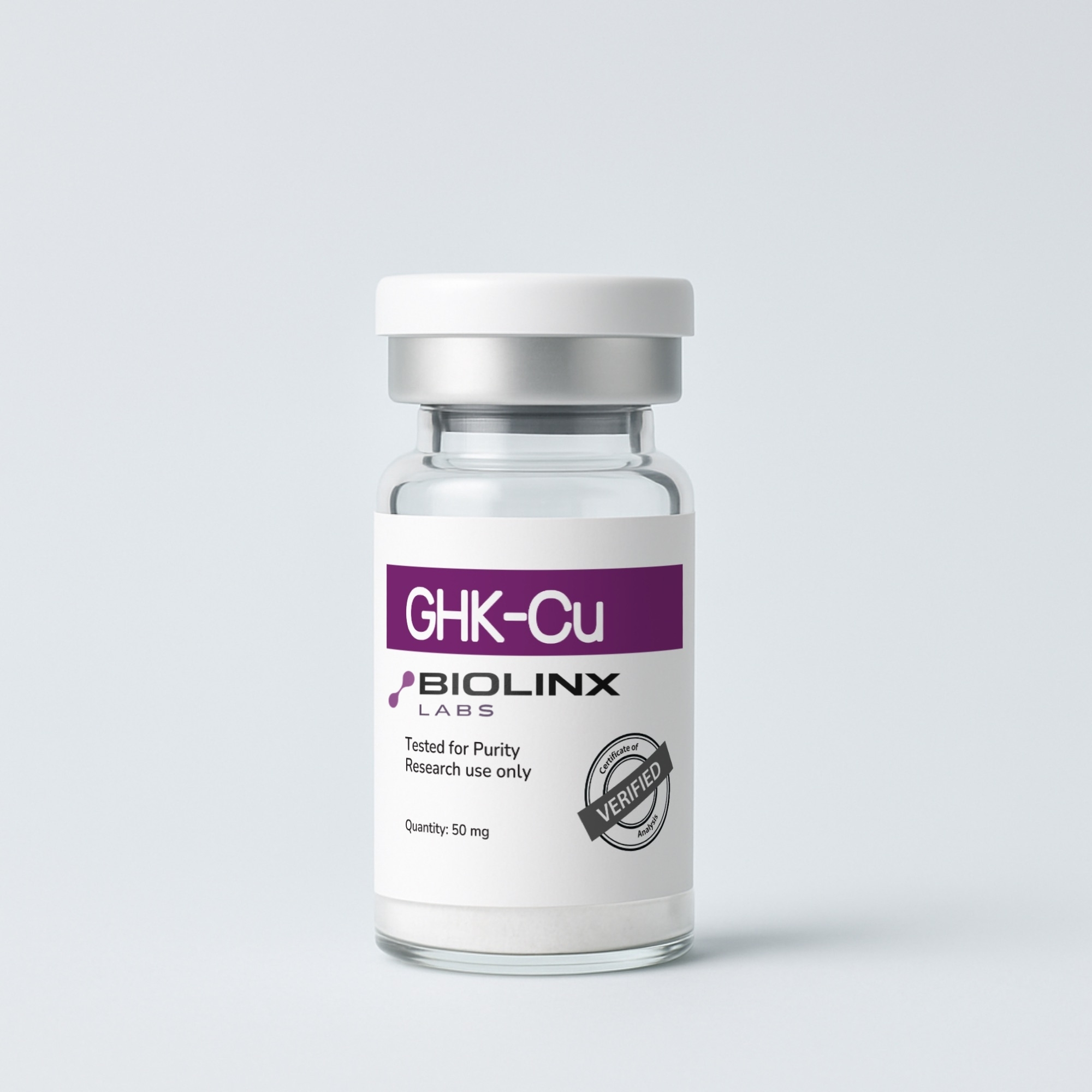
For laboratory and research use only. Not for human consumption.