
NAD+ (Nicotinamide Adenine Dinucleotide): A Research Overview
Few molecules show up in an introductory biochemistry course as often as NAD+. Nicotinamide adenine dinucleotide is a coenzyme present in every living cell, and it sits at the heart of how cells move electrons around. For laboratory work it is less a novelty than a workhorse — a defined reagent that appears in countless enzymatic assays.
Redox chemistry, in brief
NAD+ and its reduced partner NADH form a redox pair. In a great many enzyme-catalyzed reactions, NAD+ accepts a pair of electrons (and a proton) to become NADH, then hands them off elsewhere. This shuttling is the reason NAD+ turns up as a cofactor or substrate in so many metabolic pathways studied in vitro.
As a laboratory reagent
Researchers typically receive NAD+ as a lyophilized powder and use it to support or measure enzyme activity in controlled biochemical assays. Its role there is mechanistic and well established: it is a participant in electron-transfer reactions, not a finished product with an outcome attached.
Handling notes
Like other lyophilized reagents, NAD+ keeps best cold and dry, and prepared solutions are usually made fresh. Identity and content are confirmed analytically — see our explanation of net content versus gross weight for why the number on the vial and the mass of powder are not the same thing.
This overview is provided for educational purposes. NAD+ supplied here is intended for laboratory and research use only and is not for human consumption.
Research material referenced in this overview
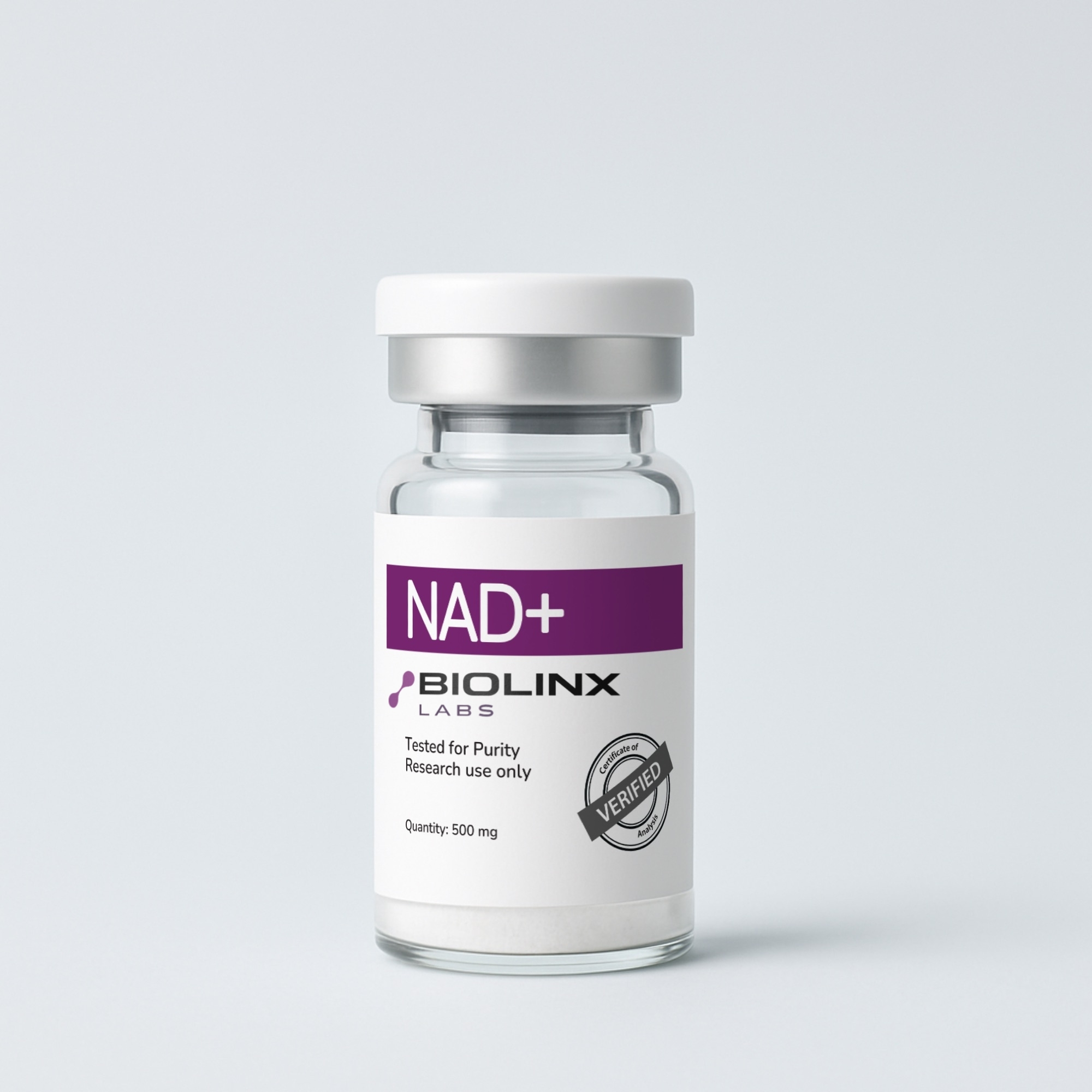
For laboratory and research use only. Not for human consumption.