
PT-141 (Bremelanotide): A Research Overview
PT-141, also known by the research name bremelanotide, is a synthetic cyclic heptapeptide that belongs to the melanocortin-agonist family. Its cyclic structure — the peptide backbone is closed into a ring — gives it stability and a defined three-dimensional shape, both useful properties when a compound is being used to interrogate a receptor.
The melanocortin system
The melanocortin receptors are a family of G-protein-coupled receptors, of which MC3R and MC4R are the ones most often referenced in connection with PT-141. In preclinical in-vitro and animal-model research, the peptide has been examined for how it interacts with these receptors and the signalling that follows activation, all under experimental conditions.
Role as a reference compound
Because it is a defined melanocortin agonist, PT-141 appears in comparative pharmacology work as a benchmark — a known quantity researchers can measure other compounds against. That is its value in the lab: a characterized tool, not a product with a claimed result.
Material and verification
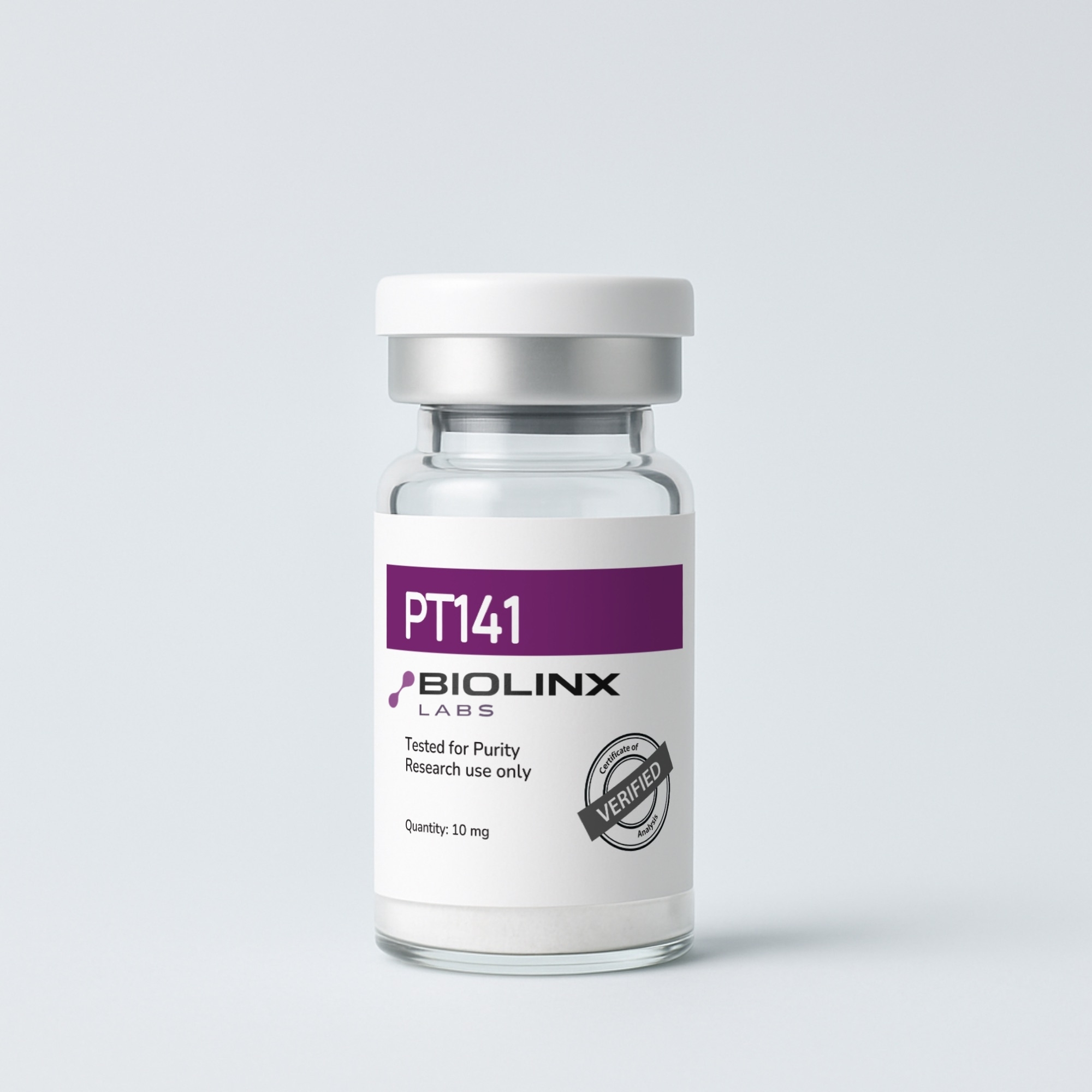
PT-141 is supplied lyophilized. As with any cyclic peptide, mass spectrometry confirms that the ring closed correctly and that the observed mass matches the calculation, while HPLC reports purity. Our primer on mass spectrometry explains how that identity check works.
This overview describes areas of scientific investigation only and makes no claim of any effect in humans. PT-141 offered here is intended for laboratory and research use only and is not for human consumption.
Research material referenced in this overview
For laboratory and research use only. Not for human consumption.