
Tesamorelin: A Research Overview
Tesamorelin is a synthetic analog of growth-hormone-releasing hormone, the hypothalamic peptide usually abbreviated GHRH. Analogs like this are built by taking the natural sequence and introducing modifications intended to change properties such as stability, which is a recurring theme in peptide chemistry.
Relationship to GHRH
GHRH acts at its own receptor as part of the signalling cascade that biologists study under the heading of growth-hormone regulation. Tesamorelin, as a GHRH analog, has been examined in preclinical in-vitro and animal-model research for how it interacts with that receptor and for the signalling associated with it — work conducted in controlled laboratory settings.
What a stabilized analog offers the lab
A more stable analog can be easier to work with than a fragile native peptide, giving more consistent behaviour across an experiment. For researchers comparing members of the GHRH family, having a defined analog on the bench is useful.
Material notes
Tesamorelin is supplied lyophilized and verified by standard analytical methods. Its molecular weight and formula, listed on the specification, can be cross-checked against the mass-spectrometry result — see our note on reading molecular weight and formula.
This overview describes areas of scientific investigation only and makes no claim of any effect in humans. Tesamorelin offered here is intended for laboratory and research use only and is not for human consumption.
Research material referenced in this overview
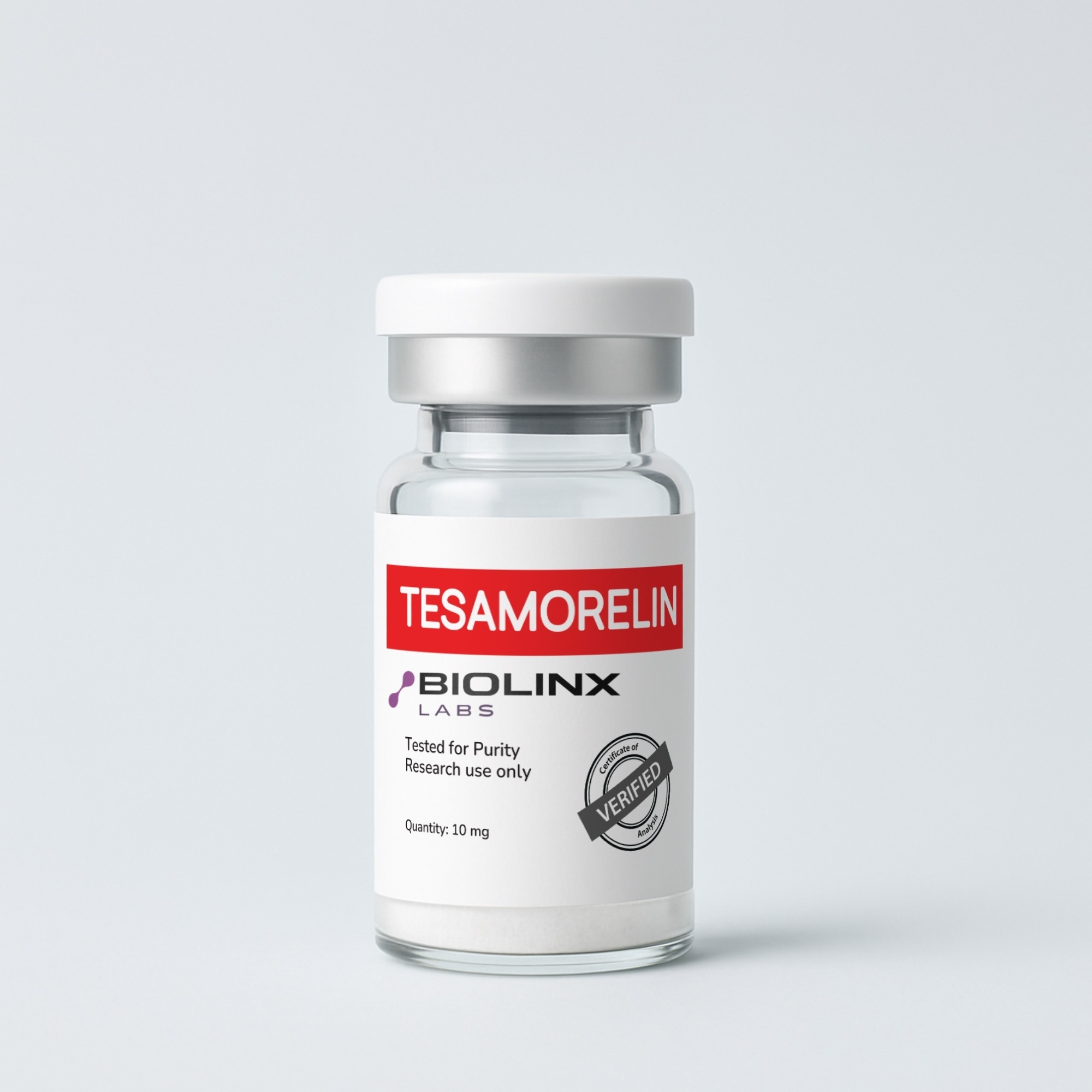
For laboratory and research use only. Not for human consumption.