
Copper Peptides in Research: The GHK Family
The GHK family centers on a single short sequence: glycyl-L-histidyl-L-lysine, written GHK. This tripeptide is small enough to fully characterize at the atomic level, which is part of why it has drawn sustained attention in coordination chemistry. The histidine imidazole, the terminal amino group, and the backbone nitrogen together create a binding pocket that holds a copper(II) ion, producing the complex commonly written GHK-Cu.
Sequence and Copper Coordination
What makes GHK chemically distinct is its high affinity for copper(II). In aqueous solution the peptide and the metal ion form a square-planar coordination arrangement, with the imidazole side chain of histidine and the amide and amine nitrogens supplying the donor atoms. Spectroscopic and crystallographic studies in the coordination-chemistry literature have mapped this geometry in detail, describing how pH shifts the protonation state of the imidazole and thereby alters how tightly the copper is held.
This metal-binding behavior is the defining feature researchers study. The copper complex is not merely GHK with a metal stuck to it; the electronic environment of the bound ion changes, and that altered redox profile is itself a subject of in-vitro investigation. Researchers examine how the complex behaves as an electron-transfer participant under controlled experimental conditions, comparing it with the free peptide and with copper salts alone.
Why the Family Matters in the Lab
GHK appears in connective-tissue fractions, and its isolation history is part of why preclinical literature returns to it. In cell-culture models, investigators have used GHK and GHK-Cu as tool compounds to probe copper handling and gene-expression signatures, always under defined laboratory conditions rather than as agents producing an outcome in an organism. The distinction matters: the published work describes molecular and cellular observations, not effects attributed to any individual.
Analytical chemists also study the GHK family as a useful model system. Because the binding constants are well characterized, the peptide serves as a reference point for studying how other histidine-containing sequences chelate transition metals. That methodological role keeps GHK in circulation across coordination chemistry, peptide synthesis, and in-vitro biology.
For readers exploring related short-peptide chemistry, our GHK-Cu research overview covers the copper complex in more depth, and adjacent classes such as the MOTS-c research overview illustrate how researchers characterize other compact peptides by sequence and origin.
Synthesis of GHK is straightforward by solid-phase methods, which supports reproducible study material. The free tripeptide and the copper complex are handled as separate entities in the literature, since their physicochemical properties differ markedly. Understanding the GHK family therefore means understanding two linked but distinct molecules: the peptide as a sequence, and the peptide as a copper-coordinating ligand.
This article is provided for educational purposes and describes areas of scientific investigation only. Products referenced are intended for laboratory and research use only and are not for human consumption.
Research material referenced in this overview
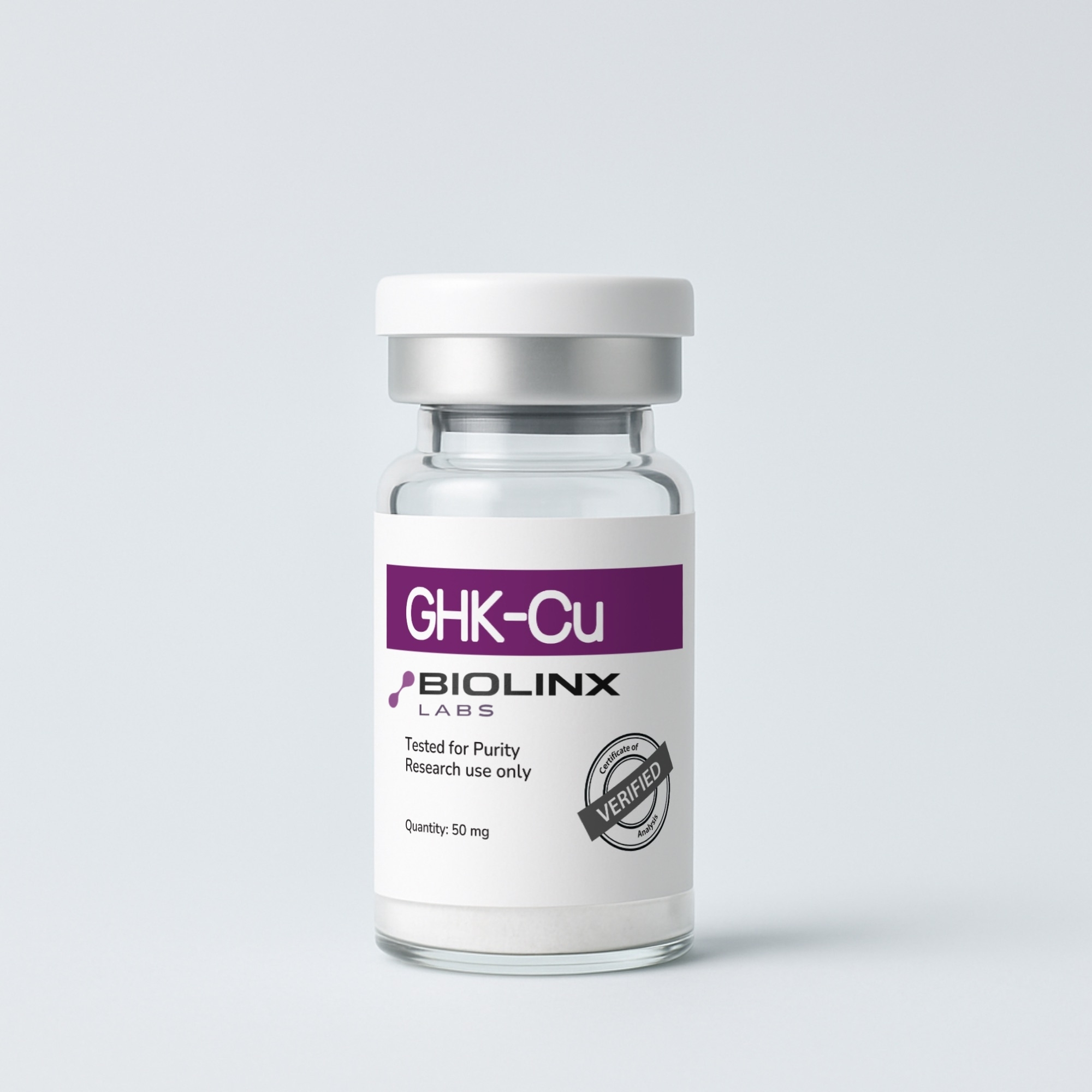
For laboratory and research use only. Not for human consumption.
Related research overviews
Thymosin Peptides: Beta-4 and Alpha-1
An overview of thymosin beta-4 actin-binding chemistry and thymosin alpha-1 molecular identity, two distinct peptides grouped under the thymosin name.
GHRH Analogs in Research
An overview of Tesamorelin and the GHRH analog class, focusing on the growth-hormone-releasing-hormone receptor relationship studied in preclinical literature.
Mitochondrial-Derived Peptides: A Research Overview
An overview of MOTS-c and the mitochondrial-derived peptide class, focusing on their origin within the mitochondrial genome and how researchers identify them.