
Mitochondrial-Derived Peptides: A Research Overview
Most peptides studied in the lab are encoded by the nuclear genome. Mitochondrial-derived peptides are an exception: they originate from short open reading frames within the small, circular mitochondrial DNA. This unusual genomic origin is the defining feature of the class and the reason it became a distinct topic in molecular biology.
Origin in the Mitochondrial Genome
The mitochondrial genome is best known for encoding components of the respiratory chain and the RNAs needed to translate them. Researchers identified additional short reading frames embedded within these regions, and translation of those frames yields small peptides. MOTS-c is among the most studied, derived from a reading frame within the 12S ribosomal RNA region of mitochondrial DNA. Its identification relied on careful sequence analysis to distinguish a genuine coding frame from the surrounding RNA gene.
Because these sequences sit inside genes with other functions, confirming that a peptide is actually produced requires biochemical evidence, not sequence prediction alone. The preclinical literature documents detection of the peptide product in cell and tissue models, establishing that the reading frame is translated. That detection work is the foundation of the field: before any function can be examined, the molecule's existence and sequence must be pinned down.
A Distinct Class of Small Peptides
What unites the class is not a shared receptor but a shared source. Members are short, they arise from mitochondrial reading frames, and they are studied as signaling molecules that may move between the mitochondrion and the rest of the cell. In cell-culture systems, investigators track where these peptides localize and which molecular pathways they associate with, all under controlled experimental conditions.
The class is still young, and much of the published work is descriptive: cataloguing candidate peptides, confirming their sequences, and characterizing their physicochemical properties. Researchers regard MOTS-c as the reference member because it is the best characterized, using it to set methods that can then be applied to newly proposed mitochondrial-derived peptides.
For a compound-level overview of the best-studied member, see our MOTS-c research overview, which covers its sequence and the in-vitro observations reported in the literature.
The interest in this class comes partly from what it implies about the mitochondrial genome itself: that a genome long thought to encode only a handful of proteins may carry additional coding capacity. Studying these peptides is therefore as much about genome annotation as about the molecules. As a research category, mitochondrial-derived peptides are defined by their origin, identified by careful biochemical detection, and characterized as small molecules studied in preclinical in-vitro and animal-model systems.
This article is provided for educational purposes and describes areas of scientific investigation only. Products referenced are intended for laboratory and research use only and are not for human consumption.
Research material referenced in this overview
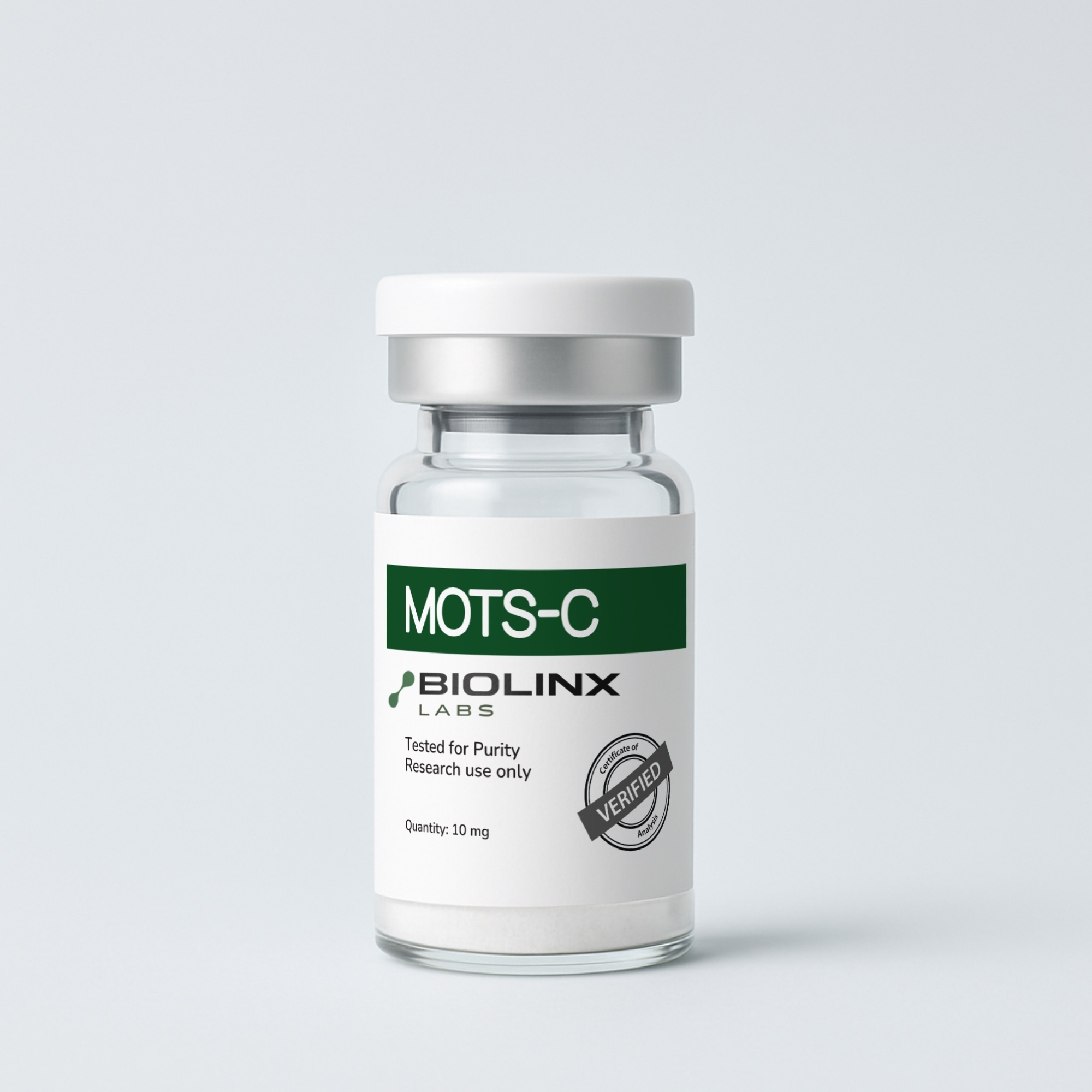
For laboratory and research use only. Not for human consumption.
Related research overviews
Thymosin Peptides: Beta-4 and Alpha-1
An overview of thymosin beta-4 actin-binding chemistry and thymosin alpha-1 molecular identity, two distinct peptides grouped under the thymosin name.
GHRH Analogs in Research
An overview of Tesamorelin and the GHRH analog class, focusing on the growth-hormone-releasing-hormone receptor relationship studied in preclinical literature.
Growth Hormone Secretagogues: A Research Overview
An overview of Ipamorelin and the GHRP class as ghrelin-receptor ligands, focusing on GHS-R1a binding and receptor selectivity studied in preclinical models.