
Melanocortin Receptor Agonists in Research
The melanocortin system is built around a family of five G-protein-coupled receptors, MC1R through MC5R, each with its own tissue distribution and ligand preferences. Synthetic peptides that bind these receptors are studied in preclinical pharmacology as tools for mapping receptor function. Two such molecules, PT-141 (bremelanotide) and Melanotan II, are frequently described in this literature strictly as receptor ligands.
Receptor Subtypes and Binding
Endogenous melanocortin signaling derives from peptides cleaved from proopiomelanocortin. The synthetic analogs of interest are cyclic peptides whose ring structure constrains their conformation, which is the structural reason they engage melanocortin receptors with measurable affinity. In radioligand-binding and functional in-vitro assays, researchers characterize how these compounds occupy MC1R, MC3R, and MC4R, and report differences in selectivity across the subtypes.
Melanotan II is a cyclic heptapeptide analog of alpha-MSH that is described as a non-selective agonist, engaging several melanocortin receptors. PT-141 is a closely related structure, a metabolite-derived analog that the literature characterizes with its own binding profile across the same receptor family. The published interest lies in comparing their cyclization, their relative receptor occupancy, and the downstream second-messenger signals measured in transfected cell lines under experimental conditions.
Signaling Read-Outs in Cell Models
Melanocortin receptors couple to Gs proteins, so the standard laboratory read-out is cyclic AMP accumulation in cells expressing a defined receptor subtype. Investigators use this assay to rank agonist potency and to distinguish full from partial activation. These are molecular observations in controlled systems; they describe how a ligand engages a receptor, not any result in an organism.
Because the receptor subtypes sit in different tissues, selectivity is the central analytical question. A compound that activates MC4R but spares MC1R behaves differently in assays than a non-selective agonist, and that contrast is what makes the pair useful as reference ligands for probing the system. Structure-activity studies in the preclinical literature systematically vary the peptide ring to ask which residues drive subtype preference.
Researchers comparing cyclic peptide ligands often place these molecules alongside other receptor-targeted peptides; see our PT-141 research overview and the Melanotan II research overview for compound-specific detail on each ligand's reported binding characteristics.
Considered as a class, melanocortin receptor agonists are valued in research for the clean, quantifiable receptor pharmacology they offer. The defined receptor subtypes, the cAMP read-out, and the well-understood cyclic structures together make this group a tractable model for studying how a GPCR family discriminates among related peptide ligands.
This article is provided for educational purposes and describes areas of scientific investigation only. Products referenced are intended for laboratory and research use only and are not for human consumption.
Research material referenced in this overview
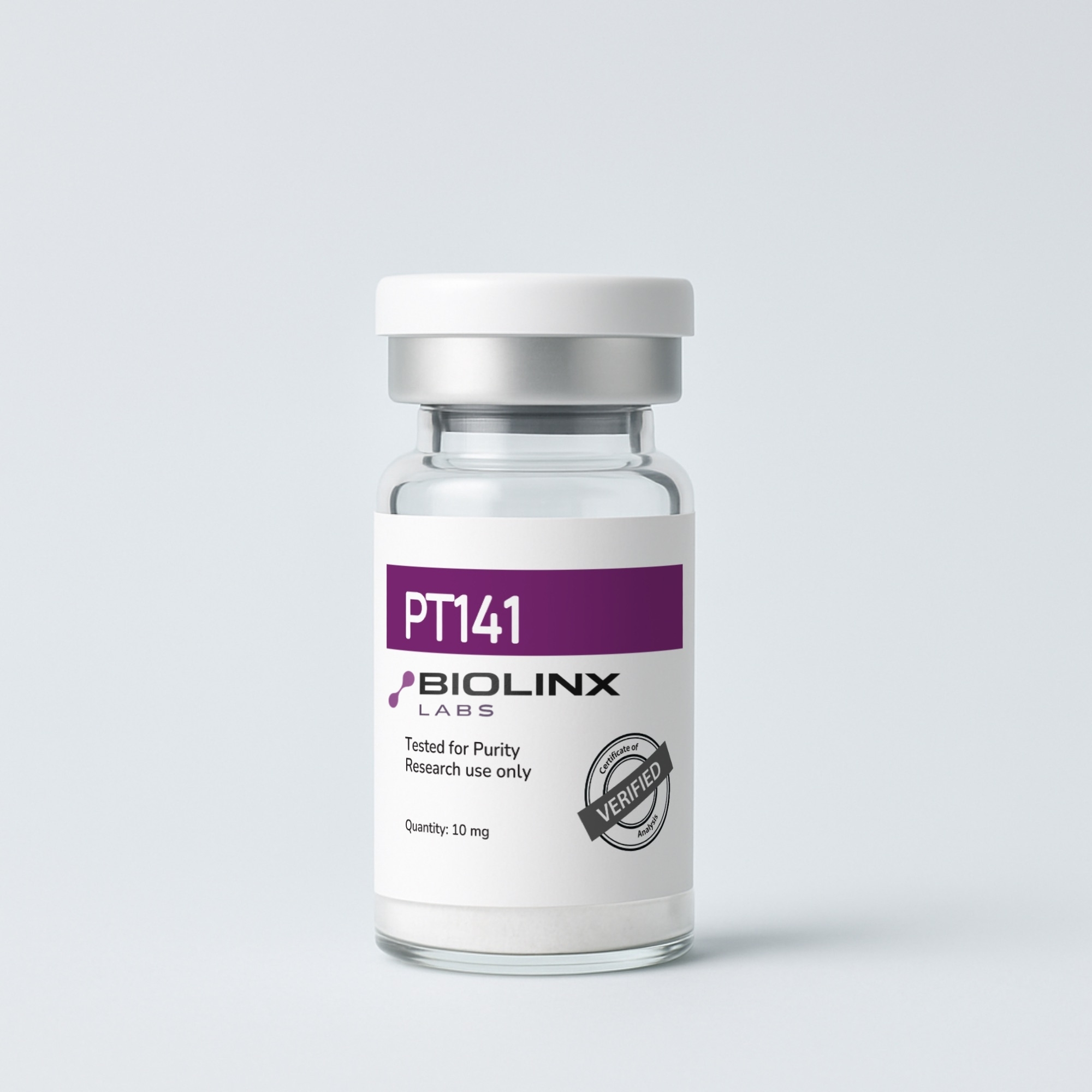
For laboratory and research use only. Not for human consumption.
Related research overviews
Thymosin Peptides: Beta-4 and Alpha-1
An overview of thymosin beta-4 actin-binding chemistry and thymosin alpha-1 molecular identity, two distinct peptides grouped under the thymosin name.
GHRH Analogs in Research
An overview of Tesamorelin and the GHRH analog class, focusing on the growth-hormone-releasing-hormone receptor relationship studied in preclinical literature.
Mitochondrial-Derived Peptides: A Research Overview
An overview of MOTS-c and the mitochondrial-derived peptide class, focusing on their origin within the mitochondrial genome and how researchers identify them.